


Last week, I gave myself a challenge: post on LinkedIn every weekday.
As uncomfortable as it feels, I know that showing up online matters. People who aren’t familiar with my work need to understand what I can offer. So each afternoon, I’d try to write something thoughtful.
And then, each time I hit “post,” the specter of social media would land on one shoulder and whisper, “Was that helpful? Will anyone engage with it? Should I have said it differently?”
Then there’s the chorus of expert advice about algorithms, optimal posting times, what to include and avoid. It’s easy to get caught up in all of it.
I know that underneath all that noise is fear. Fear of rejection. Fear of failure. Fear of judgment. One of my posts is actually about our limiting beliefs and how we can help ourselves shift to a more positive mindset. But I was having trouble applying that advice to myself.
A Different Framework
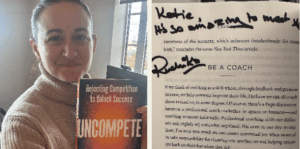
On Tuesday night, I went to a book launch for Uncompete by strategist and Harvard Business Review contributor Ruchika Malhotra. My oldest friend, Iris, is a literary agent at the agency that supported Ruchika’s book, and she invited me to join her.
The book’s premise is bold: what if competition—the thing we’ve been taught drives excellence—is actually holding us back?
Malhotra draws on research showing that an overly competitive mindset causes more harm than good. It fuels exhaustion, anxiety, burnout, and isolation. It encourages scarcity thinking and keeps us from reaching our potential.
Her alternative? Uncompete—the belief that success for all comes from choosing abundance and collaboration while intentionally rejecting competition.
The research backs this up. Studies on psychological safety show that when you feel your team has your back, you’re more innovative, productive, and creative. But in hyper-competitive environments where you feel you must keep your elbows sharp, that psychological safety disappears, which negatively influences your capacity to do your best work.
Shifting from Competition to Contribution
Watching Ruchika in conversation with two other accomplished women, I saw them model the book’s ideas in real time—lifting each other up, celebrating one another’s contributions, and choosing what Ruchika calls a mindset of abundance.
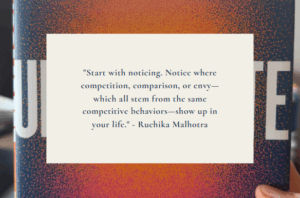
The book’s first practice is simple: start noticing where competition, comparison, and envy show up in your life. Once I started paying attention, I I saw it in my LinkedIn experiment. I wasn’t really posting to contribute; I was posting to compete.
That’s when I returned to the reason I was posting in the first place: I want to help leaders lead with greater clarity and confidence. Further, my approach to coaching centers on helping leaders understand and leverage their strengths so they can lead from authenticity rather than comparison.
It’s uncompeting in practice.
And when we shift from competition to contribution, the questions we ask ourselves change, as well:
From Competition Thinking:
Will this be good enough?
How does this compare to what others are doing?
Will people like it?
Am I measuring up?
To Contribution Thinking:
What do I have to offer?
Who might this help?
How can I show up generously?
What value can I create?
This shift matters for the people you lead, as well. When leaders help others feel like they matter, they create cultures where contribution thrives and competition fades.
What would shift if you approached your next challenge as a contribution rather than a competition?
The fear doesn’t disappear when you make this shift. But when you’re focused on what you have to offer rather than how you measure up, you give yourself permission to show up authentically.
And, perhaps, the right people will notice.