What One Senior Leadership Team Learned about Collective Strengths
Recently, I traveled to work with a senior leadership team that oversees a subsidiary of a Fortune 500 company. I started the “Our Leadership Edge” workshop with a saying often attributed to African wisdom: “If you want to go fast, go alone. If you want to go far, go together.”
It was a quote I learned at my executive coaching training, and it applies well to a group thinking about collaboration.
But by the end of that session, I realized the proverb was only telling half the story.
About 60 minutes in, I pulled up their CliftonStrengths team grid – a color-coded map of everyone’s strengths in the room. People quickly became engaged. One person said, “Oh, that’s why we…” Another jumped in: from this grid, we could characterize our team as getting things done and making friends along the way.”
They were seeing their team’s collective DNA – where they naturally excelled and the gaps they’d been working around but hadn’t previously articulated.
Then one participant talked about how his top three CliftonStrengths – Relator, Developer, and Belief – help the team work in sync toward common goals. He’d recently heard a thought leader speak about birds flying in formation, and how they move both fast and far because of how they work together. He said that’s what he tries to contribute to the team.
And that’s what I love about this exercise. The team grid does exactly that for teams.
When you understand your collective strengths, you don’t have to choose between going fast and far. You get both.

What the team grid reveals
The CliftonStrengths team grid is a tool available to certified coaches that maps where a team’s collective strengths fall across four domains: Executing, Influencing, Relationship Building, and Strategic Thinking. Here’s an example of what it looks like.
Gallup’s research shows that high-performing teams start with clarity. When teams understand their collective strengths, they make better decisions, increase productivity, and improve collaboration.
The grid shows the story of how your team naturally works together – where you excel, where you have potential blind spots, and how the concentration of certain strengths creates both advantages and challenges.
In the case of the team I was working with, their pattern was clear: they were heavy on Executing and Relationship Building. A few people carried Influencing themes, but without much concentration. One person held most of the Strategic Thinking for the entire group.
In this way, “We get things done and make friends along the way” was their actual operating system. They could also see why conversations across functions felt harder, why strategic planning sometimes stalled, why influencing the broader organization took more deliberate effort.
The resonance was clear in how participants reflected on the experience. They rated it 5 out of 5 for value, with 100% saying they were likely to apply the concepts to their work. One leader said the agenda was “perfect.” Another captured what made it valuable: “Knowing my strengths, my team’s and how we can complement each other.”
 Fast and far
That participant who connected his strengths to birds flying in formation was spot on. Birds in formation don’t sacrifice speed for distance or distance for speed. The formation itself – how they position themselves, how they work together – makes both possible.
The team grid does the same thing for leadership teams. When you see your collective strengths mapped out, you stop guessing about who should lead what, why some work feels effortless, and other work feels more challenging.
You see where you need to compensate for gaps and where you can lean into your collective power.
If your team hasn’t done this exercise, you’re missing an important opportunity to increase mutual understanding, engagement, and forward momentum. The clarity the team grid creates changes how teams operate.
If you’re curious about bringing a CliftonStrengths team workshop to your leadership team, let’s talk. I’d love to help you crack the code on your team’s chemistry so you can move both faster and farther together.
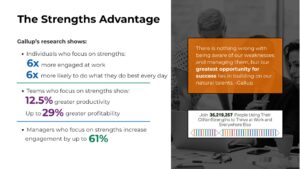
PS: If you’re not familiar with CliftonStrengths, here’s what 50 years of Gallup research reveals about why the assessment is so powerful: